
Updated 2026 edition
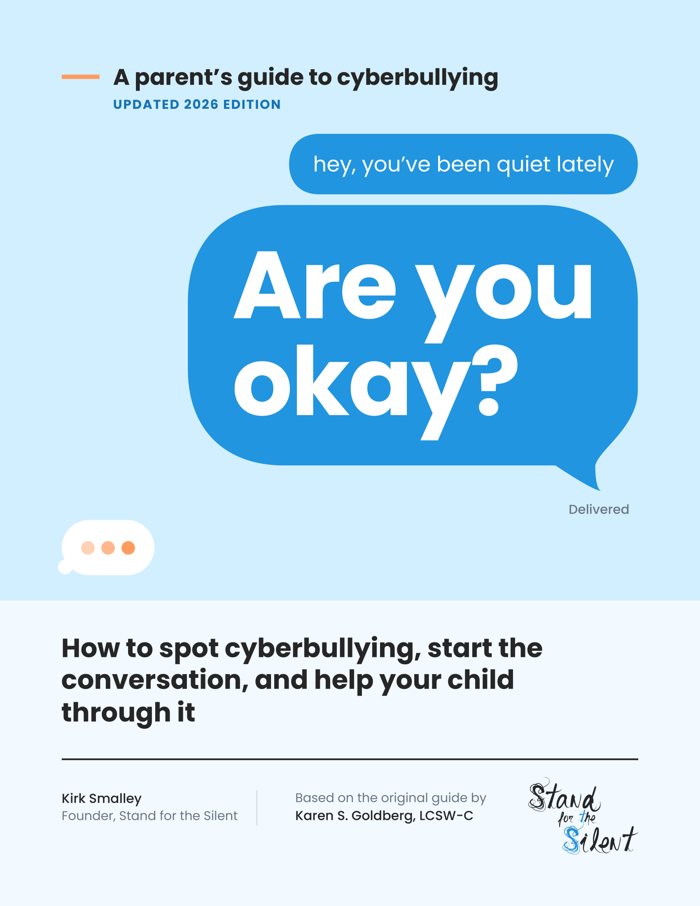
Are You Okay?
A free guide for parents and caregivers from Stand for the Silent: how to notice the signs of cyberbullying, get your child talking, and know what to do, including when AI is involved.
Read it later? We'll email it to you.
If it can't wait
Most of what happens online can be handled calmly, over a few days. These situations can't wait.
-
Someone is in danger right now
A threat of violence that could happen soon, someone who has been hurt, or a child who may act on thoughts of suicide.
-
Thoughts of suicide or self-harm
Stay with your child and call or text 988, or text HOME to 741741. If you’re worried and not sure what to do, you can call 988 on your own.
-
Someone wants, or threatens to share, a sexual image
Don’t pay and stop replying. Save the messages, never the image. Report it at report.cybertip.org or 1-800-843-5678.
What's inside
See something. Say something. Do something.
Three simple steps, each building on the last, plus a full chapter on AI.
-
See something
Notice when your child may be struggling.
The signs to watch for, why so many kids stay silent, and what's at stake.
-
Say something
Open the door, gently.
Questions that invite your child to talk instead of overwhelming them, and what to say when they tell you.
-
Do something
Take action, together.
Make a plan with your child, work with the school, and know when to bring in more help.
-
AI and your child
When the one they talk to isn't a person.
What's happening as kids turn to AI chatbots, what researchers have found, and how to make a plan.
Start here
Three things you can do today.
You don't need to read the whole guide to begin. These come straight from it.
-
Start from afar.
Many kids won't answer “Are you being bullied?” But many find it easier to talk about what's happening to other kids. Start there, and move closer only as far as they let you.
-
Take the fear out of telling.
Some kids stay quiet because they're afraid of losing their phone or getting in trouble. Tell them, before they even ask, that telling you will never get them punished.
-
Save it before you block it.
Blocking and reporting can make posts disappear. Take screenshots that show the message, the username, and the date first. For a sexual image of anyone under 18, save the messages, never the image.
If your child opens up, start with:
“Thank you for telling me. It’s not your fault. We’ll figure this out together.”
Free online toolkit
Ready-to-use tools that go with the guide.
Templates, checklists, and conversation cards for parents, school staff, and kids. Everything is free, and you can preview each one before you download it.
Who it's from
From Kirk Smalley and Stand for the Silent.
Stand for the Silent was started in 2010 by a group of students in Oklahoma City, after they heard what happened to Kirk and Laura Smalley’s son, Ty. Since then, Kirk has carried Ty’s story into schools across the country. Many of the students who hear it write to him afterward, and those letters are the reason this guide exists.
This updated 2026 edition builds on the original guide by Karen S. Goldberg, LCSW-C.
- 6,800+
- schools visited
- 4.6M
- students reached
- 195K
- messages from kids and parents

Sources
Where the guide's numbers and guidance come from.
The numbers and guidance in the guide were checked in fall 2026. This is the full list, kept up to date.