
From our free guide
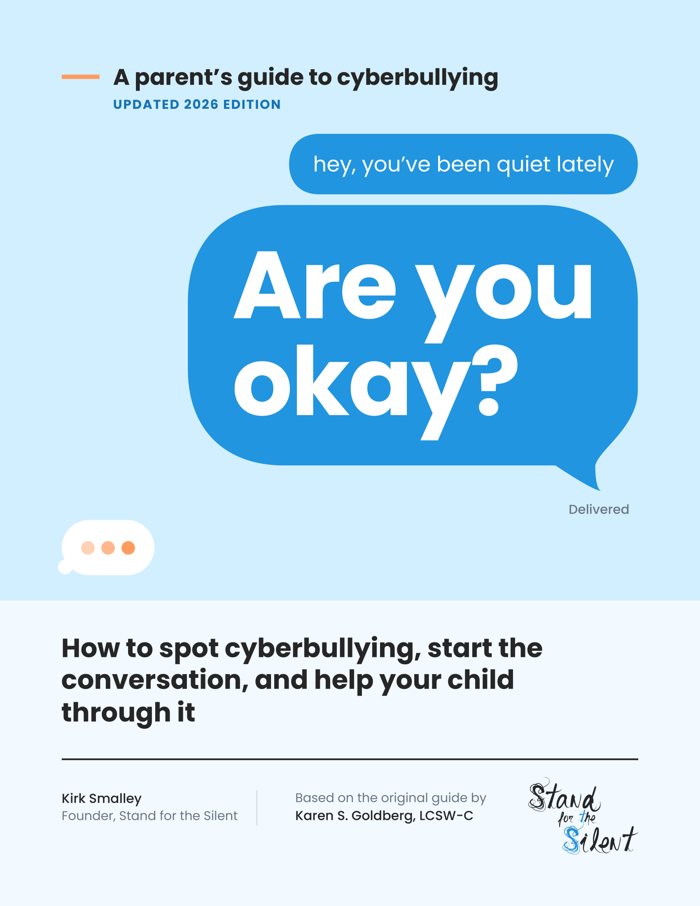
Free tools to use with Are You Okay?
Every tool here comes from Are You Okay?, our free guide to cyberbullying. The guide explains when and how to use each one, so if you haven't read it yet, start there.
Start here
Who are you?
Pick the one that fits, and we'll take you straight to the right tools.
- I'm a parent or caregiver What to do when it's happening, working with the school, tools for home, and AI.
- I'm a teacher or school staff For teachers, counselors, school administrators, and after-school leaders.
- I'm a kid or teen One page on what to do, whether it's happening to you or to someone you know.
For parents and caregivers
Tools for every step.
From the first sign to the school meeting, here's what to use and when.
When it's happening
3 tools-
Sexual images and threats: what to do
PDF, 2 pages, 237 KB
Step by step, if someone shares, makes, or threatens to share a sexual image of your child, real or AI-made.
-
Evidence log
PDF, 2 pages, 157 KB
Keep everything in one place, so you’re ready if you need to go to the school, the platform, or the police.
-
How to report on each app
PDF, 2 pages, 203 KB
Where to block, report, and lock down an account on the apps kids use most. Block first, because it works right away. Reports can be slow, so keep your own records.
Working with the school
1 toolSchool emails and meeting checklist
Three emails ready to copy and send from your phone, and what to bring, ask, and do at the meeting.
Asking for a meeting
Putting the plan in writing
Following up
At the meeting
- Bring your evidence log and printed screenshots
- Ask who will look into it and how they’ll keep your child safe in the meantime
- Ask them not to put the kids in a room together to “work it out”
- Agree on a date for your next conversation
- Send the follow-up email the same day
Still no change? Write to the principal, then the superintendent, and attach your evidence log and these emails. If the bullying is about race, national origin, sex, disability, or religion, say so in writing.
At home
3 tools-
Signs to watch for
PDF, 1 page, 198 KB
One page with the signs of cyberbullying, the signs that AI is taking the place of people, and the signs that mean don’t wait.
-
Conversation cards
PDF, 3 pages, 452 KB
Questions, “What would you do?” scenarios, and first messages to send, for the car or the dinner table when you want to talk without it feeling like a talk.
-
Making it right
PDF, 2 pages, 185 KB
For a child who has hurt someone: a worksheet to work through together, one step at a time.
AI and your child
2 tools-
Family tech and AI agreement
PDF, 1 page, 156 KB
A plan you make together, sign together, and revisit as your child grows. It covers AI companions, what AI is for, and phones at night.
-
Talking about AI
PDF, 2 pages, 199 KB
Four questions that start far away and move closer, and the one to ask when the moment feels right: “What do you get from it that you’re not getting somewhere else?”
For teachers and school staff
You see kids every day.
Three free tools for you, the kids you work with, and their families.
-
Staff guide: when a student discloses an image
PDF, 1 page, 190 KB
What to do, and what not to do, when a student comes to you about a sexual or AI-made image.
-
Scenario discussion guide
PDF, 2 pages, 223 KB
A ready-to-run group discussion using the “What would you do?” scenarios, for grades 6 to 12.
-
Letter to families
PDF, 1 page, 163 KB
A short letter introducing the guide, ready for your logo and signature.
Invite Stand for the Silent
Bring Kirk Smalley's story to your school.
Since 2010, Kirk has shared his son Ty's story with students across the country, and thousands of kids have found the courage to speak up.
- 6,800+
- Schools visited
- 4.6M
- Students reached
- 195K
- Messages from kids and parents
For kids
If you're a kid looking for help, you're in the right place.
Something going on? You don't have to handle it alone. Talk to someone you trust, and if it ever feels like too much, call or text 988, any time.
-
What to do
PDF, 1 page, 197 KB
One page: if it’s happening to you, if you see it happening to someone else, or if you did it. With room to write down three people you trust.
The guide
Every tool here comes from Are You Okay?
Our free guide to spotting cyberbullying, starting the conversation, and helping your child through it, including what every parent needs to know about AI.